INOX 304
Stainless steel (Inox) 304 and 304L (also known as grades 1.4301 and 1.4307 respectively). Inox 304 is the most versatile and widely used type, found in various fields of life. It is sometimes still referred to by its old name 18/8, derived from the nominal composition of type 304, which is 18% chromium and 8% nickel. Stainless steel 304 is an austenitic type that can be deep drawn and has good ductility, dominating applications such as sinks and cookware. Type 304L is the low carbon version of 304. It uses components to improve weldability. Some products like sheets and pipes can be dual certified as 304 and 304L. 304H, a high carbon content variant, is used at high temperatures.
The properties presented in this data table are typical references for flat-rolled products applied by the ASTM A240 / A240M standard or equivalent standard specifications.
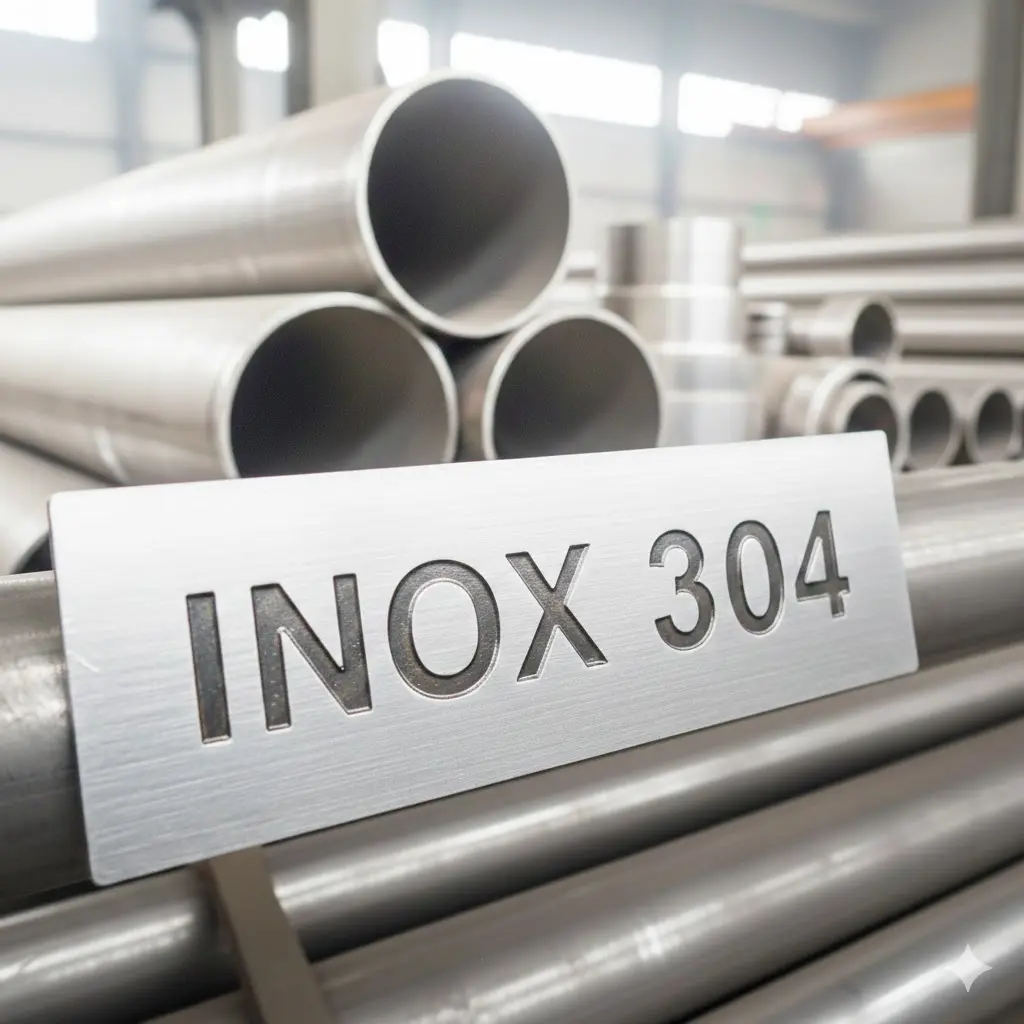
Stainless steel 304 is used in:
1.Production: kitchen utensils, pots and pans, stoves, cabinets, shelves, knives, forks…
2. Sanitary equipment, washbasins, industrial tanks, sterile rooms
3.Interior and exterior decorative panels
4.Applications in piping, machinery in the food, industrial, chemical, beverage, and pharmaceutical industries...
Springs, screws, nuts & bolts, construction accessories, chemicals
Stainless steel 304 can be in the form of: Sheets, Coils, Pipes, Solid bars, Profiles, Pre-cast, Machined, Accessories, Flanges.
Corrosion resistance of Stainless Steel 304: 304 has excellent corrosion resistance in highly corrosive environments when exposed to various corrosive media. However, surface pitting and crevice corrosion can occur in environments containing chlorides. Stress corrosion can occur above 60 °C.
Heat resistance of Stainless Steel 304: 304 has good oxidation resistance in intermittent conditions up to 870 °C and in continuous conditions up to 925 °C. However, continuous use in temperature environments of 425 °C - 860 °C is not recommended. In this case, 304L is recommended due to its resistance to carbide precipitation. Type 304H is recommended for regular use at temperatures above 500 °C and up to 800 °C; this material will retain its water corrosion resistance.
Fabrication and structure of Stainless Steel 304.
The fabrication of all types of stainless steel should only be performed with tools dedicated to stainless steel material. The surfaces of tools and workpieces must be thoroughly cleaned before use. These precautions are necessary to avoid cross-contamination of stainless steel by metals that are prone to corrosion, which can discolor the surface of the fabricated product.
Cold Working: Stainless steel 304 is easy to harden. Fabrication methods involving cold working may require an intermediate annealing stage to relieve work hardening and avoid tearing or cracking. Upon completion of fabrication, a full annealing operation should be used to reduce internal stress and optimize corrosion resistance.
Hot Working: Fabrication methods such as forging, involving hot working, should occur after uniform heating to 1149-1260 °C. The fabricated components should then be rapidly cooled to ensure maximum corrosion resistance.
Machinability: 304 has good machinability. Machining can be improved by following these rules: Cutting edges should be kept sharp, cuts should be clean, and the low thermal conductivity of the Austenitic alloy leads to overheating at the cutting edge. This means it is necessary to use coolant and lubricant when cutting continuously.
Heat treatment: Stainless steel 304 cannot be hardened by heat treatment. Solution treatment or annealing can be performed by rapid cooling after heating to 1010 -1120 °C.
Weldability: The fusion welding performance for stainless steel 304 is excellent whether or not filler material is used. The recommended filler rod and electrode for stainless steel 304 is stainless steel 308. For 304L, the recommended filler/ welding rod is 308L. Deep welds may require post-weld annealing. This step is not mandatory for 304L. Grade 321 may be used if post-weld heat treatment is not possible.
Chemical composition of Inox 304
| Ingredient - Element | % Rate |
Carbon (C) | 0.07 |
Chromium (Cr) | 17.50 - 19.50 |
Manganese (Mn) | 2.00 |
Silicon (Si) | 1.00 |
Phosphorous (P) | 0.045 |
Sulphur (S) | 0.015b) |
Nickel (Ni) | 8.00 - 10.50 |
Nitrogen (N) | 0.10 |
Iron (Fe) | Balance |
For machinability, a controlled sulfur content of 0.015 - 0.030% is recommended and permitted.
Mechanical properties
Mechanical Properties | Value |
Comprehensive Strength | 210 MPa |
Proof Stress | 210 Min MPa |
Tensile Strength | 520 - 720 MPa |
Elongation | 45 Min% |
Physical Properties
Rationality - Properties | Value |
Density | 8,000 Kg/m3 |
Melting Point | 1450 °C |
Thermal Expansion | 17.2 x 10⁻⁶ /K |
Modulus of Elasticity | 193 GPa |
Thermal Conductivity | 16.2W/m.K |
Electrical Resistivity | 0.072 x 10⁻⁶ Ω .m |
Source: Thyssenkrupp
Editor: Inox Đông Hải