INOX 316
ỨNG DỤNG CỦA INOX 316
Applications and Chemical Components
INOX 316/316L includes all types of shapes such as: hot rolled, cold rolled in sheets, coils, welded pipes, cast pipes, U/V shaped steel, bars, and wires suitable for various purposes.
Applications of inox 316:
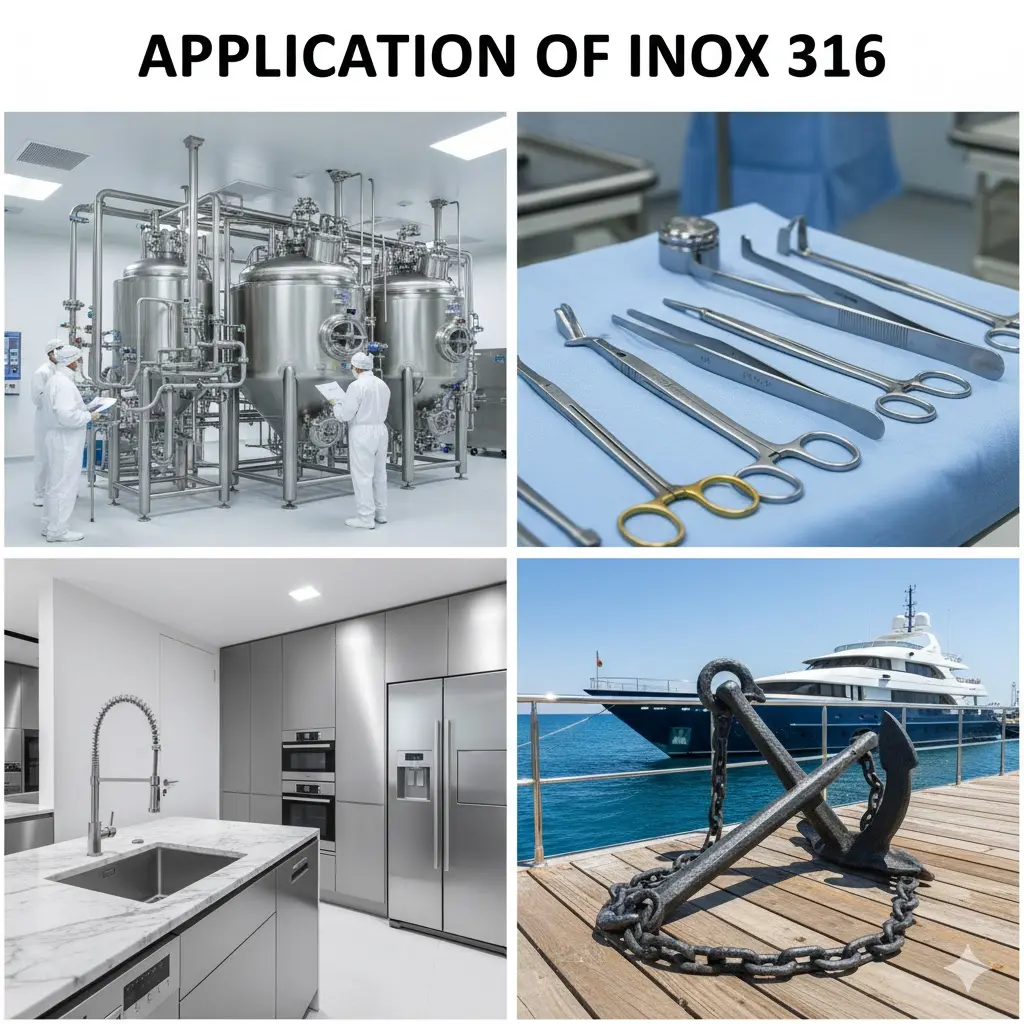
Industrial, civil, and defense construction, offshore material technology, tanks, storage containers, pipelines for chemical carriers, manufacturing plants, warehouses, and transportation of chemicals, food, beverages, and medical supplies. Due to its Mo content >2.5%, it has good resistance to environments containing chlorides, acids, and is non-oxidizing. Under welded material conditions, its corrosion resistance is better ensured than other types of stainless steel for large products with the same material thickness.
Chemical Composition Table of 316 - Chemical Compositions
| Element | % Present |
| Carbon (C) | 0.07 |
| Silicon (Si) | 1.00 |
| Manganese (Mn) | 2.00 |
| Phosphorous (P) | 0.045 |
| Sulfur (S) | 0.0151) |
| Chromium (Cr) | 16.50 - 18.50 |
| Nickel (Ni) | 10.00 - 13.00 |
| Nitrogen (N) | 0.10 |
| Molybdenum (Mo) | 2.00 - 2.50 |
| Iron (Fe) | Balance |
Mechanical & Physical Properties - physical properties
| Specific weight - Density at 20°C kg/m3 | 8.0 | |
| Thermal Conductivity W/m K at 20°C | 15 | |
| Modulus of Elasticity kN/mm2 at | 20°C | |
| 200°C | 186 | |
| 400°C | 172 | |
| 500°C | 165 | |
| Specific Thermal Capacity at 20°C J/kg K | 500 | |
| Electrical Resistivity at 20°C Ω mm2/m | 0.75 |
Welding standard, guide on how to weld for Inox 316:
MAG-Welding Wire
Arc Welding (E)
Submerged Arc Welding (SAW)
Laser Welding
When selecting the type of welding wire, the filler material for the weld, and corrosion stress must also be considered. The use of a higher alloy welding wire may be necessary due to the casting structure of the welded metal. Preheating is not necessary for this steel.
Post-weld heat treatment is usually not normal: Austenitic steel has only 30% of the thermal conductivity of non-alloy steel. Their melting point is lower than that of non-alloy steel, therefore austenitic steel must be welded with lower heat input than non-alloy steel. To avoid overheating or burning through thinner plates, a higher welding speed must be applied. Copper backup plates to dissipate heat faster are functional; however, to avoid cracks in the weld metal, it is not allowed to melt the surface of the copper backup plate.
This steel has a much higher thermal expansion coefficient than non-alloy steel. Due to the poorer thermal conductivity, greater distortion must be taken into account. When welding 316, all processes that counteract this distortion (e.g., step-back sequence welding, alternating welding on two opposite sides of a double V weld, assigning two welders when the corresponding components are large) must be respected. For product thicknesses over 12 mm, a double V groove weld should be preferred over a single V groove weld. The included angle should be 60° - 70°; when using MIG welding, about 50° is sufficient.
Continuous overlay welds should be avoided. Overlay welds should be made with relatively short distances between them (significantly shorter than for non-alloy steels) to prevent strong distortion, shrinkage, or spalling of the welds. The welds should be ground afterward or at least free of crater cracks. Inox 316 is very suitable for laser beam welding (welding capability A9in according to DVS 3203, part 3). With a weld groove width of less than 0.3 mm corresponding to a product thickness of 0.1 mm, the use of filler metal is unnecessary. For larger weld grooves, similar filler metal can be used. To avoid oxidation on the surface of the weld during laser beam joining, inert gases such as helium can be used; the weld seam has corrosion resistance similar to the base metal.
Inox 316 is very suitable for cutting with nitrogen laser beams or oxy-fuel cutting. The cut edges only have small heat-affected areas and usually do not have small cracks, making them very easy to form.
Color annealing, scale, slag residues, tramp iron, and spatters must be removed to avoid destroying the passive layer. For surface cleaning, polishing, grinding, pickling, or blasting processes (iron-free silica or glass beads) can be applied. Only stainless steel brushes can be used for brushing. Cleaning the previously brushed weld area is done by dipping and spraying; however, paste or cleaning solutions are often used. After careful soaking, rinsing with water must be performed.